
Choosing Between Liquid Cooling and Air Cooling for Your Facility
As technologies like AI and cloud computing progress, traditional air cooling systems often struggle to maintain optimal temperatures in high-density data centers. According to Vertiv’s Data Center Trends 2025 report, average rack densities could soar to 500-1000kW in facilities focused on AI, necessitating advanced cooling methods. Without such systems, you risk overheating and unexpected downtimes that can be costly to rectify.
Explore the distinctions between liquid cooling and air cooling, and discover how to select the most suitable option for your operations. At CDP Corp., we understand that air cooling has been a staple choice for many data centers, yet it may not always suffice for the growing demand of high-density racks. Liquid cooling emerges as an optimal solution, adept at supporting high-density equipment and preventing overheating.
Understanding How Liquid and Air Cooling Function
Ensuring your data center operates effectively requires a robust cooling system. Equipment generates excess heat that must be dissipated to avert system failures. Both air and liquid cooling achieve this but utilize different mechanisms. Air cooling uses air as the medium to absorb and dissipate heat from IT infrastructure, fitting well in less densely packed environments. Precision cooling systems, providing rack, row, and room solutions, are common to accommodate varying facility dimensions.
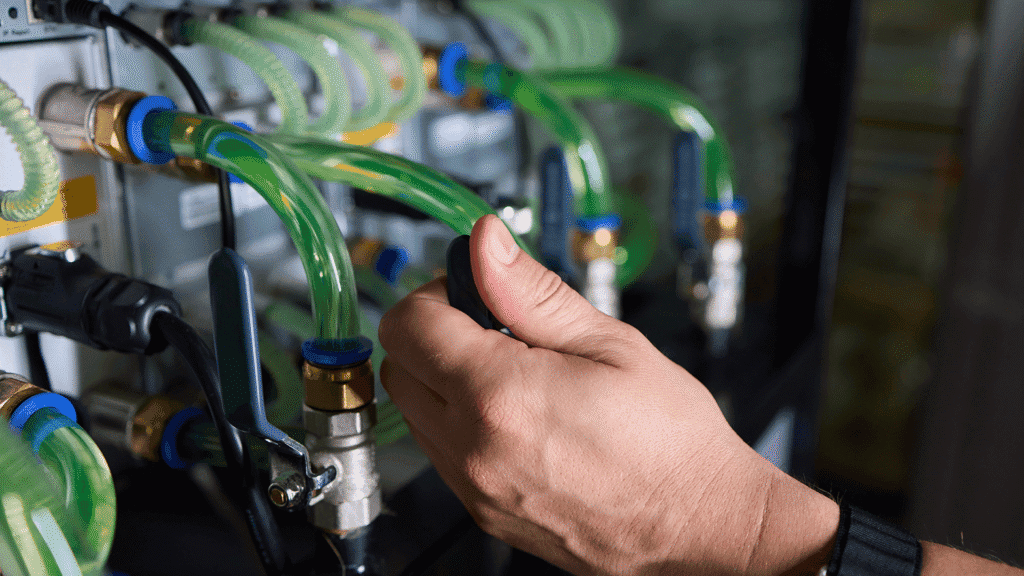
Conversely, liquid cooling introduces water or specialized nonconductive liquids to absorb and lower the temperature of heat-producing components. This system is more direct and capable of handling higher densities. Liquid cooling’s three principal techniques include:
- Direct-to-chip cooling: Targets coolant to specific chips, such as with the Vertiv™ CoolChip CDU.
- Rear door heat exchangers: Installs on server racks to remove expelled heat, as exemplified by the Liebert® DCD Water-Cooled Passive Rack Door.
- Immersion cooling: Submerges servers in a nonconductive liquid to absorb heat.
These methods are more efficient than air cooling and better suited for higher density environments.
Determining the Right Cooling System for Your Data Center
Deciding on the appropriate cooling solution hinges mainly on the density of your racks. For setups using under 20kW, air cooling remains adequate as it efficiently handles lower power and heat levels. Consider systems like the Liebert DS Direct Expansion Cooling System, which replaces hot air with cool air.
However, for racks utilizing 20kW or more, liquid cooling becomes essential. Beyond 30kW, it’s typically a necessity due to the increased heat output that traditional air methods cannot manage. A hybrid approach employing both air and liquid cooling can be advantageous, adjusting to fluctuations in temperature and density demands.
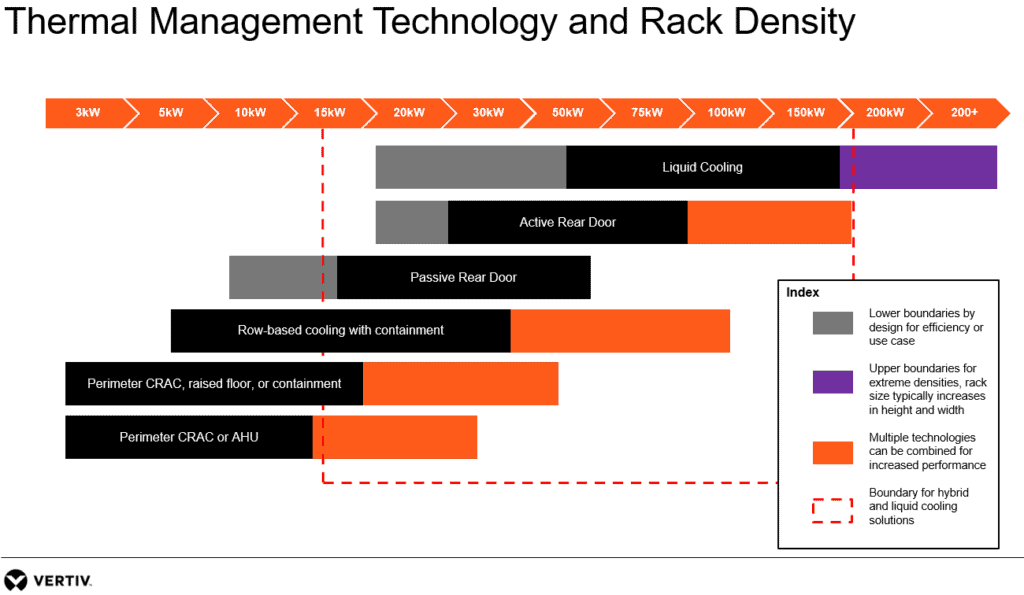
As AI requires more high-density servers, hybrid cooling systems are increasingly the norm, helping cut costs and manage heat more efficiently. Innovations like the Vertiv™ CoolChip CDU are designed to cater to hybrid cooling, utilizing liquid directly on chips and air for the surrounding room, reducing energy use.
Enhance Your Facility’s Environment
Optimal equipment performance relies not only on temperature regulation but also on an organized and secure setup. With rapid technological developments, knowing how to start optimizing your cooling infrastructure can be daunting. Subscribe to our newsletter for insights on the latest technologies and practices designed to keep your facility at peak performance. For personalized advice and solutions, contact us at 262.542.7900.
Frequently Asked Questions About Liquid Cooling
What is the main advantage of liquid cooling over air cooling? Liquid cooling is more efficient in dissipating heat in high-density environments, offering better performance for demanding applications.
When should I consider switching to liquid cooling? If your rack density exceeds 20kW, liquid cooling may be necessary to effectively manage heat output and maintain system stability.
Can liquid cooling be combined with air cooling? Yes, a hybrid approach can optimize cooling efficiency, especially in facilities with varying density requirements.
What are the primary methods of liquid cooling? Direct-to-chip, rear door heat exchangers, and immersion cooling are three main methods employed to manage heat in high-density setups.
Does liquid cooling consume more power than air cooling? While the initial setup may use more power, liquid cooling systems are often more energy-efficient in high-density environments, resulting in lower overall power consumption over time.